
EliteSiC Solutions for Energy Storage Systems

Battery Energy Storage Systems (BESS) is a fast-growing industrial market to meet the power storage demands of the switch from carbon-based energy sources to more renewable and sustainable methods. Many countries also offer incentives to install these energy storage systems, which has increased the need for energy storage in residential, industrial, and commercial applications. Energy storage systems are needed in Solar Systems and EV Charging Stations, using similar components and topologies as well.
System Implementation
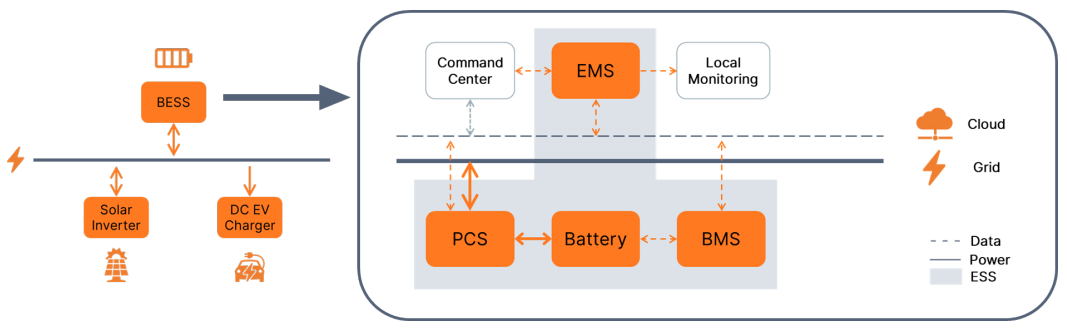
System Description
Four Elements to Build BESS
A BESS is made up of 4 parts, whether it is for residential or commercial use. Battery packs consist of hundreds or thousands of battery cells to set up a commercial level system, and high-voltage modules are integrated into the battery racks or banks for higher capacity. Charging and discharging voltages typically range from 50 V to 1100 V, dependent on the battery voltage and circuit topology. BMS (Battery Management System) is an electronic system managing rechargeable batteries by ensuring batteries are operating in SOA (Safe Operating Area), monitoring operating states, calculating and reporting real-time data, etc. to ensure a longer operational life. PCS is another important sub-system for bidirectional conversion of energy between the battery pack and the grid and/or load, a big factor in determining the system cost, size and performance. EMS is a software-based system of computer-aided tools used by operators of electric utility grids to monitor, control, and optimize the performance of the generation or transmission system.
AC-coupled System and DC-coupled System
BESS is currently segmented into 2 types, AC-coupled and DC-coupled systems. AC-coupled BESS is a separated system that can be added to existing solar/energy generation system/grid, making it an easy upgrade. However, it requires additional power conversion stages to accomplish full charging/discharging, leading to higher losses. On the other hand, DC-coupled system, commonly employed in residential hybrid solar inverters, offer extra energy storage capacity by connecting to the DC bus. It involves single DC-DC conversion step but requires a decision during product design, as DC bus voltage is often high and may pose safety or retrofitting challenges.
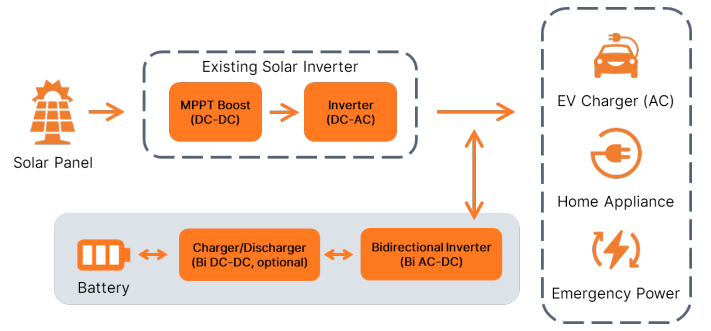
Figure 2: AC-coupled System
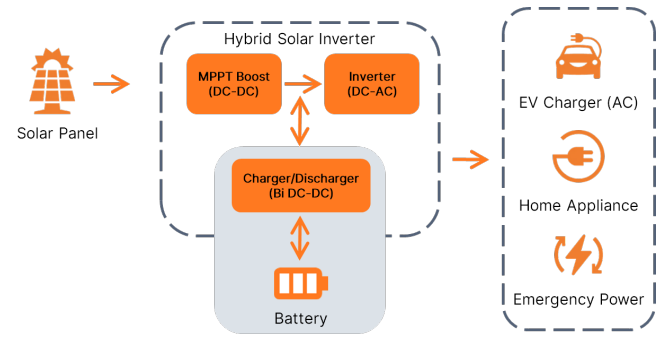
Figure 3: DC-coupled System
Bidirectional Operation
The power conversion stage of BESS requires bidirectional operation. Commonly, three-phase inverters can be bidirectional and behave as an AC-DC converter when operating in reverse mode, reactive mode for UPS or braking mode for motor drive. In general, power converters, and in particular topologies, are optimized for one use case and one direction of the power flow through the selection and relative sizing of the switches and diodes. Three−phase inverters used as AC-DC converters in PFC mode will not be as efficient as an optimized AC-DC PFC converter. Even DC-AC topologies designed to be bidirectional will show better performance in one direction than the other. So, it is important to bear in mind what will be the most common use case. Also, bidirectionality will not be achievable with all topologies, so selecting the right one upfront is an important factor. Read AND90142 - Demystifying Three-Phase Power Factor Correction Topologies to understand three-level technology and featured three-level PFC circuits.
Use Silicon Carbide Products in PCS
Compared to IGBT, Silicon Carbide (SiC) devices have more advantages in high-voltage and high-current applications, such as enabling high-frequency switching. Although IGBT remains the preferred choice in BESS design, considering different switching strategies, incorporating SiC devices in certain sections can yield superior performance. For instance, in the bidirectional inverter using A-NPC, SiC devices may be selected in the inner legs to reduce switching losses because of the dedicated switching strategy requiring high switching frequency of inner switches, while the rest switches can still utilize low VCE(SAT) IGBTs to maintain controllable cost.
Learn more about Battery Energy Storage Systems (BESS) by downloading the onsemi BESS System Solution Guide here!
Additional Links


Pairing Gate Drive to EliteSiC
“Energy Infrastructure applications like EV charging, energy storage, Uninterruptible Power Systems (UPS), and solar are pushing system power levels to hundreds of kilowatts and even megawatts. These high-power applications employ half bridge, full bridge, and 3-phase topologies duty cycling up to six switches for inverters and BLDC. Depending on the power level and switching speeds, system designers look to various switch technologies, including silicon, IGBTs, and SiC, to best fit application requirements.
While IGBTs offer superior thermal performance vs. silicon solutions in these high-power applications, EliteSiC by onsemi enables both higher switching speeds and high power. onsemi offers a complete portfolio of SiC MOSFETs ranging from 650V to 1700V breakdown voltage, with RDSONs as low as 12mΩ. But, every SiC MOSFET requires the correct Gate Driver to maximize system efficiencies and minimize the total power losses. This easy-to-use table below pairs the correct Gate Driver to each SiC MOSFET”.
| EliteSiC MOSFETs | Gate Driver: 5kVRMS Galvanic Isolation | ||||||
| GI: 3.75kVRMS | GI: 5kVRMS | ||||||
| 1-Channel (source/sink) | 2-Channel (source/sink/matching) | ||||||
| V(BR)DSS: | RDSON (typ): | Package: | 4.5A / 9A | 6.5A / 6.5A | 7A / 7A | 6.5A / 6.5A / 20ns | 4.5A / 9A / 5ns |
| 650V | 12 – 95mΩ | 3-LD, 4-LD, 7-LD, TOLL, PQFN88 | 4NCP(V)51752 30V Output Swing (SOIC-8) |
13NCD(V)5709x 32V Output Swing (SOIC-8) |
123NCD(V)5710x 32V Output Swing (SOIC-16WB) |
NCD(V)575xx 32V Output Swing (SOIC-16WB) |
1NCP(V)5156x 30V Output Swing (SOIC-16WB) |
| 750V | 13.5mΩ | 4-LD | |||||
| 900V | 16 – 60mΩ | 3-LD, 4-LD, 7-LD | |||||
| 1200V | 14 – 160mΩ | 3-LD, 4-LD, 7-LD | |||||
| 1700V | 28 - 960mΩ | 4-LD, 7-LD | |||||
Gate Driver: Peak Source Current / Peak Sink Current / Total Propagation Delay Matching
1 Supports: External Negative Bias Turn Off
2 Supports: Desaturation (Over current) Protection
3 Supports: Active Miller Clamp (Over current) Protection (clamps VGS preventing accidental turn on during intended turn off)
4 Supports: Internal Negative Bias Turn Off.
"V" Supports Automotive Qualification

| Short Description | |
| NCP51752 | 3.7 kV Isolated High Performance SiC Drivers |
| NCD5709x | 5 kV Isolated Single Channel Gate Driver |
| NCD5710x | 16-pin Wide Body Isolated Gate Driver |
| NCD575xx | 5 kV Isolated Dual Channel Gate Driver |
| NCP5156X | 5 kV Isolated High Speed Dual MOS/SiC Drivers |
| NCV51752 | 3.7 kV Isolated High Performance SiC Drivers |
| NCV5709x | 5 kV Isolated Single Channel Gate Driver |
| NCV5710x | 16-pin Wide Body Isolated Gate Driver |
| NCV575x | 5 kV Isolated Dual Channel Gate Driver |
| NCV5156x | 5 kV Isolated High Speed Dual MOS/SiC Drivers |